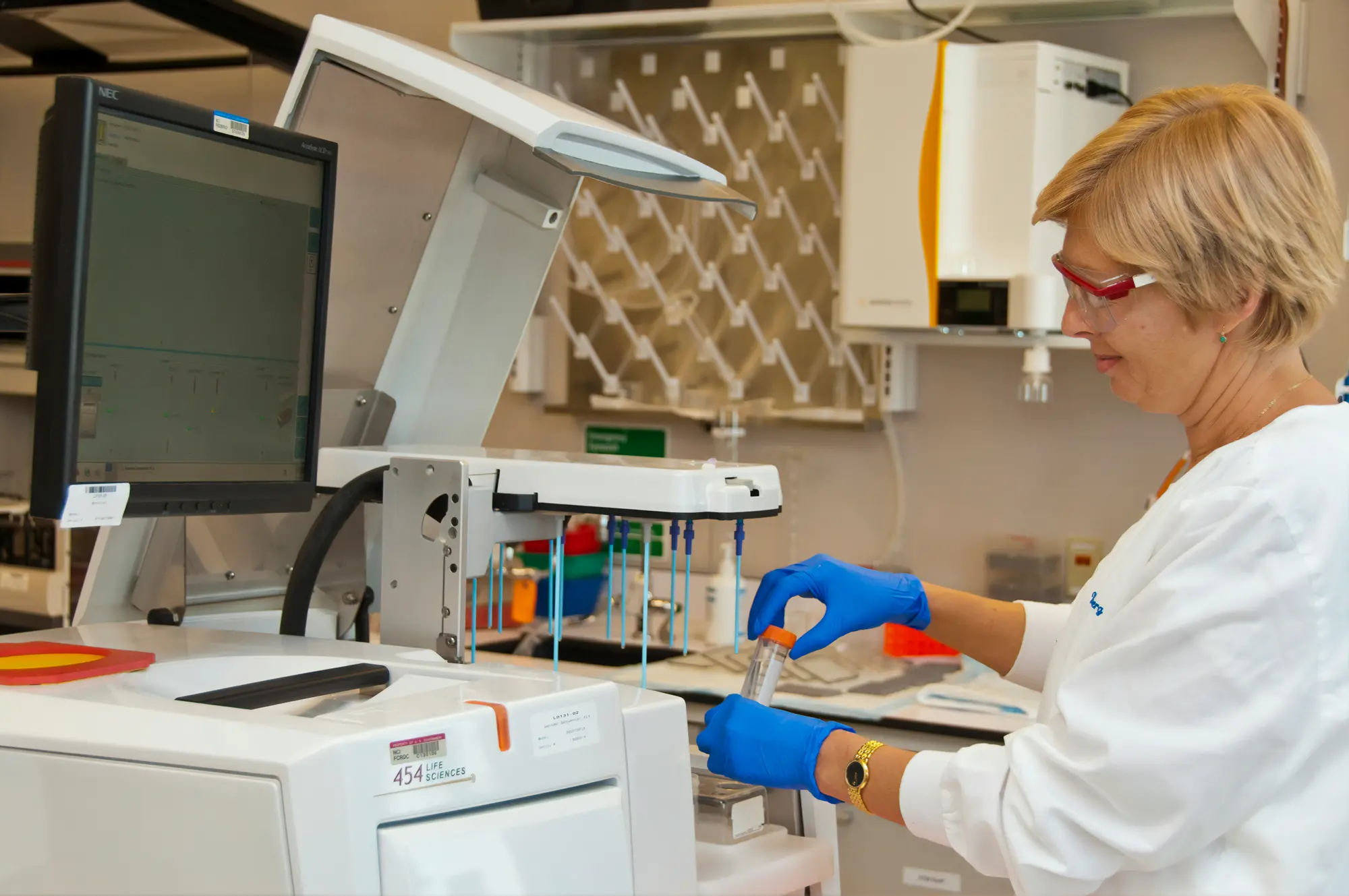
From a single gene fragment to a complete genome, short-read, long-read and Sanger capacity routed to verified national laboratories whose declared platforms match your project.
Sanger remains the confirmation technology: nothing beats it for verifying a cloned insert, confirming an edit or variant, or barcoding a specimen. Providers sequence purified PCR products or plasmids with your primers or standard vector primers, delivering ~500–1000 bp of clean read plus the raw chromatogram (.ab1) so you can inspect every base call.
PCR product verificationDNA barcodingChromatograms included
What the lab needs
Purified PCR product or plasmid at declared concentration
Sequencing primer(s)
Expected sequence or reference where available
What you get back
.ab1 chromatogram per reaction
Consensus sequence (FASTA/text)
Quality-trimmed read length report
02
Microbial whole-genome sequencing (WGS)
Microbial WGS is the highest-volume genomics application in Pakistan's clinical, food-safety and agriculture labs. Short-read runs (Illumina MiSeq/NextSeq/NovaSeq X) deliver accurate draft assemblies; adding long reads (ONT or PacBio) resolves plasmids, rRNA operons and repeats into closed, circularized genomes. Downstream typing, MLST, serotyping, AMR and virulence panels, rides on the same data.
De novo assemblyAMR & virulence typingHybrid assembly
What the lab needs
Pure culture or extracted gDNA
Expected genus/species where known
Short-read only vs hybrid strategy preference
What you get back
Draft or closed assembly (FASTA)
Assembly QC (N50, coverage, contamination check)
Typing report (MLST/AMR) where requested
03
Plant, animal & human WGS
For complex eukaryotic genomes the design question is coverage and read length: 30×+ short-read resequencing suits variant discovery against a reference; long reads (PacBio HiFi, ONT) deliver the contiguity needed for de novo assembly of plants, livestock and novel organisms. Providers state which platforms and depths they can deliver, so quotes are comparable on like-for-like designs.
Illumina · PacBio · ONTResequencing & de novoVariant-ready output
What the lab needs
Species and genome-size estimate
HMW DNA or raw sample + extraction
Target coverage / assembly goal
Reference genome where one exists
What you get back
Aligned BAM/CRAM or de novo assembly
Coverage & mapping QC
Variant calls where analysis is included
04
Epigenome sequencing
Epigenomics splits by method: bisulfite conversion followed by sequencing (whole-genome WGBS or reduced-representation RRBS) is the established Illumina route; Oxford Nanopore detects 5mC and 6mA natively on the same run as the base sequence, no conversion, no extra library. ATAC-seq adds chromatin accessibility for regulatory studies. Providers declare which assays they actually run, list only what is confirmed.
WGBS / RRBSNative ONT methylationATAC-seq
What the lab needs
DNA or cells at assay-specific quantities
Target regions vs whole-genome scope
Platform / assay preference
What you get back
Methylation calls (CpG context)
Coverage report per region
DMR-ready aligned data
05
Transcriptome / RNA sequencing
RNA-seq design hinges on the library: poly-A selection for coding transcriptomes in eukaryotes, rRNA depletion for bacterial or degraded samples, stranded protocols for antisense resolution. Short-read bulk RNA-seq powers differential-expression studies; long-read transcriptomics (Iso-Seq-style or direct RNA) resolves full-length isoforms and splicing that fragments miss.
RNA at RIN ≥ provider threshold (or raw stabilized sample)
Replicate design and comparison groups
Library type preference or guidance request
What you get back
Aligned expression-ready reads
Counts matrix where analysis is included
Library QC (insert size, duplication rate)
06
Shotgun metagenome sequencing
Shotgun metagenomics sequences everything in the sample, no primers, no marker-gene bias, so you recover species, strains, genes and pathways simultaneously. It is the right choice for functional questions (resistomes, metabolic capacity) and for recovering metagenome-assembled genomes. Host-depletion options matter for high-background samples like tissue or swabs.
Species + functionMAG recoveryGut · soil · water
What the lab needs
Environmental or host-associated sample
Expected microbial fraction
Depth target / host-depletion need
What you get back
Taxonomic & functional profiles
MAGs where requested
QC-filtered reads and reports
07
Amplicon metagenome sequencing
Amplicon profiling is the high-throughput survey method: one marker gene amplified and sequenced across dozens or hundreds of samples. 16S rRNA covers bacteria and archaea, ITS covers fungi, 18S covers broader eukaryotes. Cheaper per sample than shotgun, it answers 'who is there and at what relative abundance' for cohort, environmental and agricultural studies.
16S rRNAITS / 18SHigh-throughput cohorts
What the lab needs
Extracted environmental DNA
Marker region choice (or guidance)
Sample count / cohort size
What you get back
ASV/OTU table
Taxonomy assignments
Diversity metrics & summary report
Ready to post your request?
Verified labs quote independently, compare price, turnaround and scope side by side.